
Process Art vs. Product Art: Fostering Curiosity in Toddlers
Process art vs product art explained for parents of toddlers: how open-ended, tactile creativity builds fine motor skills, confidence and decision-making, with four home ideas and a look at the atelier approach.
Every parent knows the paper pumpkin. An orange circle, a green stalk and two googly eyes, cut and arranged by an adult so that it looks right on the fridge. It is cute, and a toddler had very little to do with it. Now picture the other kind of artwork that comes home: a page of brown swirls, three thumbprints and a hole where the sponge pressed too hard. Parents often wonder which one shows learning. The answer sits in the process art vs product art question, and it shapes what a child practises in the early years. This guide explains the difference, what each builds, four ways to try process art at home, and how our atelier approaches it.
Process art vs product art: In process art, children choose materials and explore freely, so the experience matters and no two results match. In product art, an adult provides a model to copy, so the finished piece matters. One builds creative decision-making; the other builds following directions.
Process Art vs Product Art: Decoding the Core Differences
NAEYC, the US early childhood association, describes product-focused art as work that usually asks children to follow directions or copy samples. It describes process art as a choice-driven, open-ended activity where teachers offer minimal guidance. In process art, open-ended creative exploration means there is no wrong way to make a mark, so there are no errors to fix.
Dimension | Process art | Product art |
Objective | Explore materials and ideas | Finish a piece that matches a model |
Child’s role | Decides what to make and how | Follows the steps |
Adult’s role | Sets up materials, observes, asks questions | Shows the sample, often tidies the result |
Emotional state | Curious and relaxed, free to try | Can feel pressure to get it right |
Skill acquisition | Grip, control, mixing, decision-making | Following instructions, cutting, gluing |
Product art is not the villain. The same NAEYC article credits product-focused art with supporting fine motor and executive function skills too. Cookie cutter crafts and expressive art differ in who is doing the thinking. In process art, the child is. Montessori, Reggio Emilia and IB PYP each handle art a little differently, and our comparison of the three sets them side by side.
Fine Motor, Cognitive and Sensory Benefits of Process Art
Process art for toddlers starts in the hand, and the benefits of process art preschool classrooms see begin there. Tactile mark making with unusual tools, such as bundles of pine needles or a natural sponge, ask a child to grip in new ways. That practice supports the pincer grasp and hand-eye coordination and, over time, readiness for a tripod grip. Many open-ended tasks also use both hands: one steadies the paper while the other makes marks. That is bilateral coordination at work.
Next comes visual-spatial processing. When blue and yellow blend on paper, a child sees cause and effect and learns where marks sit on a page. Harvard’s Center on the Developing Child notes that early experiences shape brain architecture, and hands-on art is one such experience. We cannot watch a toddler’s brain at work, but we can see the hand getting steadier. For a wider view of what to expect at each stage, read our guide to early childhood development benchmarks and age criteria.
The Emotional Dividend: Resilience, Agency and Self-Esteem
A child copying a model can start to worry: “Did I colour outside the line?” The goal becomes pleasing someone else. The process art vs product art difference shows up in feelings too. In process art, a mistake is just another mark, so children practise trying things without fear. This fits the IB learner profile, which includes the attributes Inquirers and Risk-takers. The IB describes Risk-takers as people who approach uncertainty with forethought and determination.
The words adults use matter too. Our guide to inquiry-based learning for toddlers explains why questions work better than verdicts. “Good job” ends the conversation. A specific observation keeps it going:
• “I see how you pressed hard to make those thick dots.”
• “You mixed two colours and a new one appeared.”
• “Tell me about the line that goes all the way across.”
4 Simple Process Art Explorations for Home (Mess-Safe and Screen-Free)
These sensory painting activities for toddlers use non-toxic tactile mediums, meaning washable paint labelled for children. Supervise throughout and keep anything small out of mouths. To see how we plan learning at school, our preschool programme page lays it out.
1. Texture Stamping with Nature
Set-up: leaves from plants you know are safe, pine needles tied into a bundle, a wooden block, a tray of paint and paper.
Try: Press an item into the paint, then onto the paper. Compare the marks. Wash and dry natural items first, and skip anything with berries or thorns.
Say: “What do you notice about this mark?”
2. Kitchen Sponge and Pipette Colour Absorption
Set-up: a tray, torn pieces of kitchen sponge, coloured water in small cups and a large plastic dropper or spoon.
Try: Squeeze colour onto the sponge and watch it spread. Fine motor art activities for early years do not get simpler than this, since squeezing builds hand strength.
Say: “Where did the colour go?”
3. Finger Paint Symmetry on Wet Paper
Set-up: a sheet of thick paper dampened with a cloth, and two or three finger paint colours.
Try: Dab and smear the paint. Fold the paper in half, press, and open it to reveal a mirror print.
Say: “What happened when we folded it?”
4. Rolling Ball Tray Tracks
Set-up: a shallow tray lined with paper, a little paint and a large ball, too big to fit through a toilet roll tube.
Try: Roll the ball through the paint, then tip the tray to send it across the paper. Skip marbles for young toddlers because they are a choking risk.
Say: “Which way will it roll?”
The Atelier Experience at Pathways Early Years Golf Course Road
The Reggio Emilia approach began in the Italian city of Reggio Emilia, and its atelier is a studio where children work with materials. A home has a table, a tray and a bedtime. A purpose-built studio can give children time and space to return to an idea.
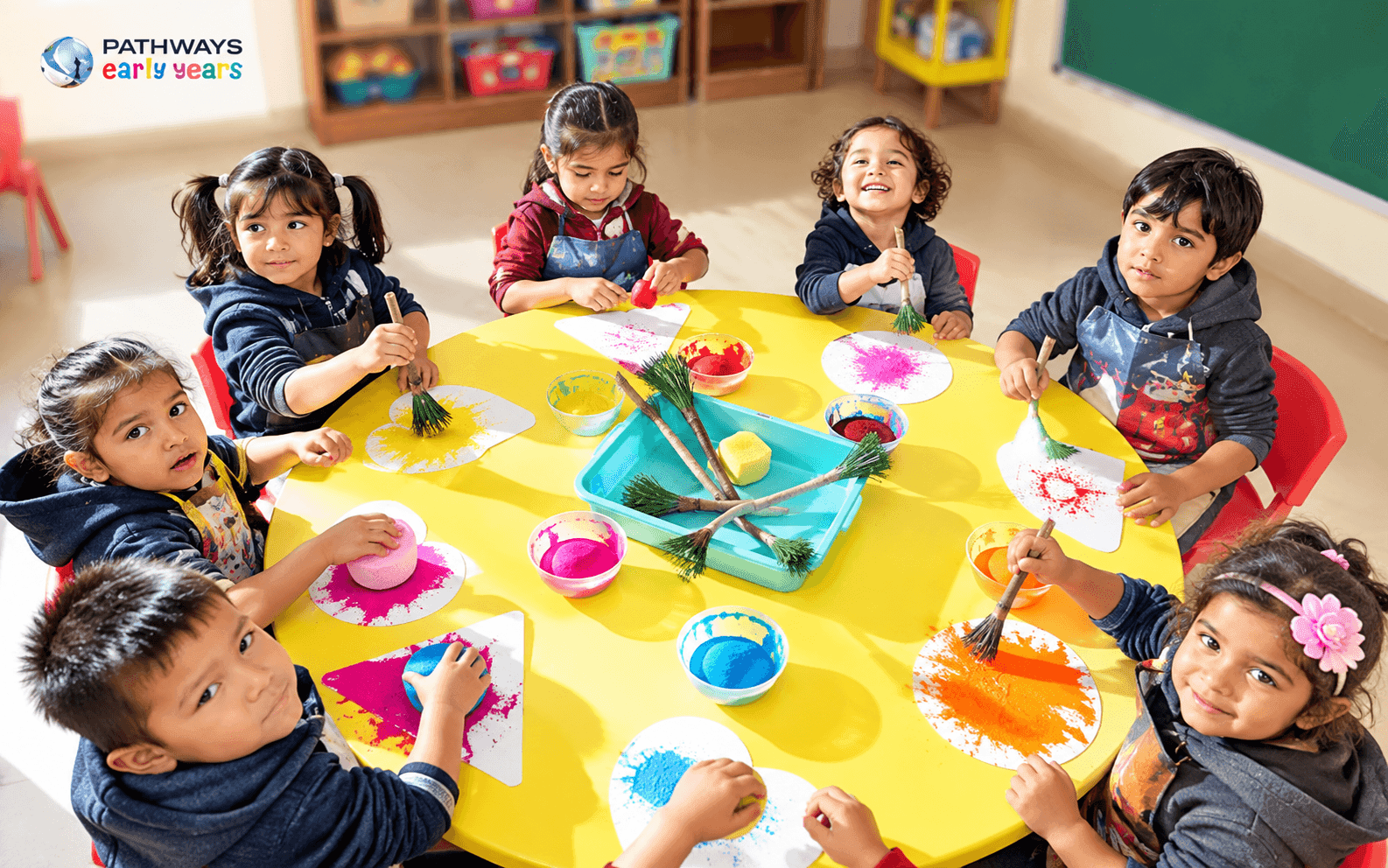
In our atelier, children sit around circular learning tables and work with tools such as pine-needle bundles, natural sponges, soft bristle brushes, gouache and tempera paints, and geometric paper cutouts. No two creations look alike. Some children stamp textures, some blend gradients, and others explore drag-and-lift patterns, with no pre-drawn black lines to stay inside.
The IB describes play as the primary driver for inquiry in the early years, and our programme follows the IB early years approach. Expressive arts sit inside the IB PYP early years framework, and process art is part of what we mean by an inquiry-led early years curriculum. For working parents, our extended daycare facilities in gurgaon serve children aged 2 to 6, with afternoon and extended hours.
Key Takeaways for Conscious Parents
• Process over product: the experience of making builds more than the finished piece.
• Messy is meaningful: scribbles and swirls show a hand and a mind making choices.
• Describe, don’t judge: swap “Good job” for what you actually see.
• Open tools help: sponges, brushes and natural items build grip and coordination.
• Balance matters: guided crafts have a place, but open-ended time deserves room too.
Campus Walkthrough: See the Atelier in Action
Descriptions only go so far, and the process art vs product art difference is easiest to see in person. If you are looking for the best preschool on golf course road, ask to see how children work with materials, and notice what teachers say when a painting turns out unexpected. Whether you live in DLF Phase 5 or commute to Cyber City, you can contact our team to arrange a visit to our campus in Sector 55.
Conclusion
The process art vs product art choice is really a choice about who does the thinking. When children lead, they practise decisions, grip, patience and the courage to try something unfamiliar. Those habits matter long after the paper pumpkin has faded. Start small this week with a sponge, some washable paint and a sheet of paper. Say what you see, then leave room for the surprise.
About the Author
Pathways Early Years Editorial Team
Frequently Asked Questions
The work is about exploring materials, not copying a model. Scribbles show a hand gaining control and a child making choices. Ask your child to tell you about it, then describe what you see instead of asking what it is.
There is no set age. Many toddlers can begin with large tools, washable paint and close supervision from around 18 months. Follow your child’s interest, and stop when it fades.
Work on a tray over an old sheet, use washable paint, and put your child in an apron or old clothes. Paint outdoors or in the bathroom when you can. Keep a damp cloth close.
It builds hand strength, grip control and the habit of making marks, all of which writing uses. It is one contributor, not a guarantee. Writing also needs direct teaching later.
Describe what you notice. Try “You pressed hard here” or “I see three colours.” Ask open questions such as “What happened when the colours met?” This keeps your child thinking about their own work.
Do not force it. Offer a brush or sponge, or let them paint inside a sealed zip bag. Keep a damp cloth within reach. Many children warm up when they control how much they touch.
The IB describes play as the primary driver for inquiry, so art tends to appear inside play and projects, not as a separate lesson. Teachers observe, ask questions and let children lead. Our programme follows the IB early years approach.
A colouring book is not harmful in itself. The concern is balance. If it is the only art a child does, they get little practice at deciding for themselves, so make room for open-ended materials too.
Get in Touch
Still have questions? Fill out the form below and our team will get back to you shortly.