
Montessori vs. Reggio Emilia vs. IB PYP: Which Preschool Methodology is Right for Your Child?
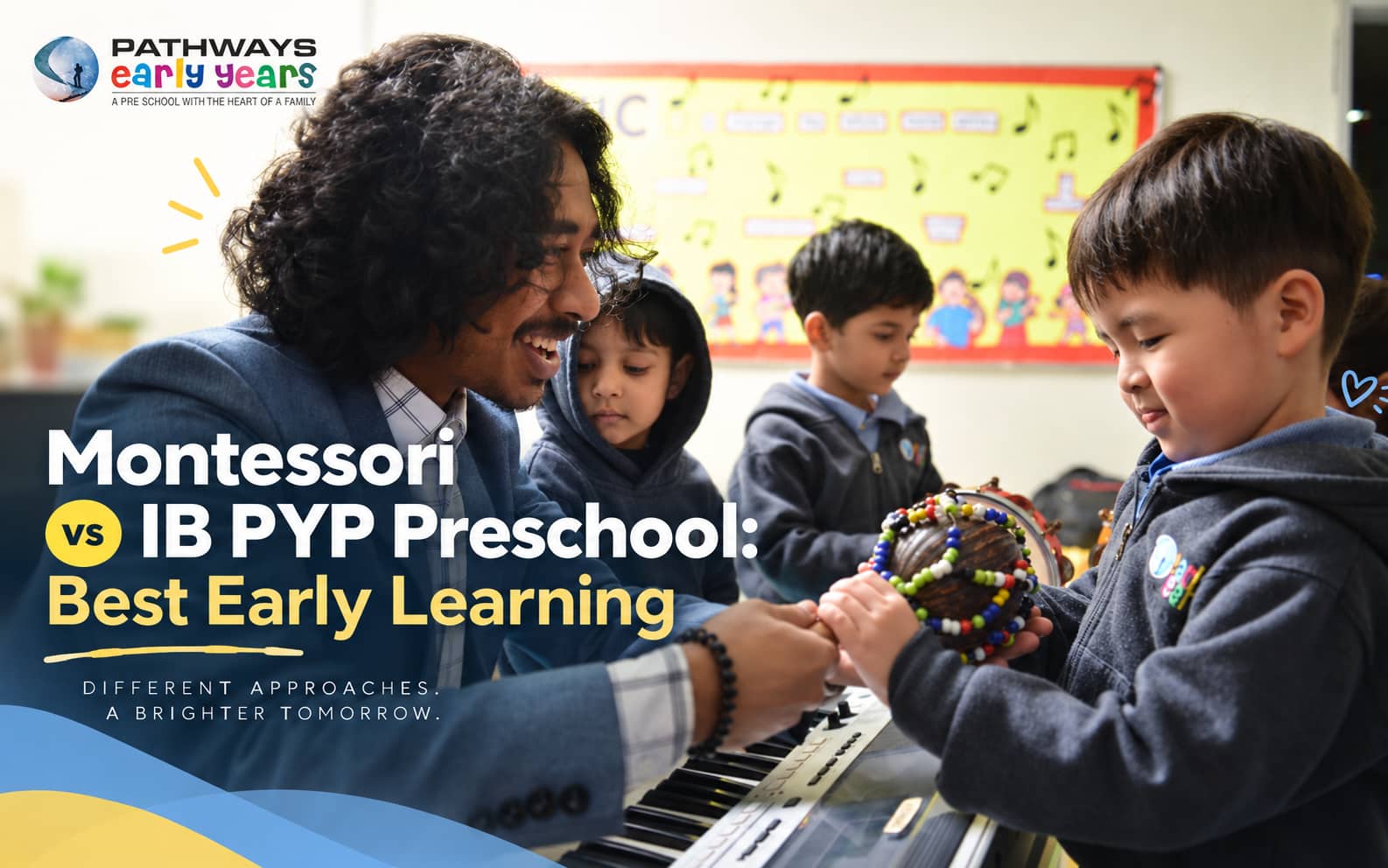
Montessori builds independence through self-directed work, Reggio Emilia builds creativity through open-ended projects, and IB PYP builds critical thinking through collaborative inquiry. Fit depends on your child's temperament and school plan
In a Montessori vs IB PYP preschool comparison, with Reggio Emilia as the third option, the direct answer is this: Montessori is best for a child who thrives on independent, ordered work; Reggio Emilia is best for a highly creative, expressive child; and IB PYP is best for a curious, social child who is headed for an international primary school. All three are credible methods. The right one is the one that matches your child's temperament and where you want them to be at age six.
For working parents in DLF Phase 5, Golf Course Road and the wider Gurgaon corridor, the choice is complicated by marketing. Every second campus describes itself as Montessori, Reggio-inspired, play-based or international, often all at once. This guide separates what each methodology actually is, what it does well, where it falls short, and how to decide for a child who will move into a formal school in a few years. If you want the campus-visit checklist first, start with our guide on how to choose the best preschool and come back to the comparison.
The three methods in one glance Montessori: self-directed mastery; child works alone with prescribed materials; teacher observes and guides. Reggio Emilia: creative expression; child-led projects, art and documentation; environment is the "third teacher". IB PYP: transdisciplinary inquiry; children investigate big ideas together; teacher is a co-learner; structured path into international primary school. |
What is the Montessori method? Pillars, materials and realities
The Montessori method is an approach developed by Dr Maria Montessori in Rome in 1907, in which children choose their own work from a prepared set of hands-on materials and repeat it until they master it. The educator prepares the environment, demonstrates a material once and then steps back to observe.
Four features define a genuine Montessori classroom:
• Self-directed work cycles: Long, uninterrupted blocks, often two to three hours, in which each child chooses an activity, completes it and returns it to the shelf.
• Didactic materials: The pink tower, sandpaper letters, golden beads and similar tools are designed so the child can see their own error without an adult correcting them.
• Multi-age groups: Three-year spans (typically ages three to six together), so older children model for younger ones.
• The observing educator: A "directress" who introduces materials individually and intervenes as little as possible.
What Montessori does well
Children in strong Montessori settings develop unusual concentration, fine motor control, order and independence. A four-year-old who can pour, button, sort and sequence without adult help is a common sight. Self-discipline is built into the method rather than imposed from outside.
What parents should weigh
Because the work cycle is individual, peer collaboration is lighter than in inquiry-based settings. Materials have one correct use, so open-ended problem-solving and group debate get less practice. And "Montessori" is not a protected term: a montessori school in gurgaon may be fully trained and equipped, or it may be a conventional playschool with a few wooden trays.
If you are searching for the best montessori school in gurgaon, or specifically a montessori school on golf course road gurgaon, ask three things before committing: Are lead educators Montessori-certified (AMI or AMS)? Is the full material set present in each room? And what is the plan for the move to a formal school, since most Gurgaon primary schools do not run Montessori beyond kindergarten?
What is the Reggio Emilia approach? Creativity and the third teacher
The Reggio Emilia approach began in the Italian town of the same name after the Second World War, shaped by educator Loris Malaguzzi. Its central idea is that children communicate through a "hundred languages", including drawing, building, movement and drama, and that learning emerges from long, child-led projects in a rich physical environment.
The approach rests on a few distinctive practices:
• The environment as the third teacher: After parents and educators, the room itself teaches. Light, natural materials, mirrors and an art studio (the atelier) are deliberate provocations.
• Emergent, project-based curriculum: There is no fixed syllabus. A child's interest in shadows or birds may become a multi-week group project.
• Documentation: Educators photograph, transcribe and display children's thinking so that learning is visible and revisited.
• Educator as researcher: Adults co-construct the project with children rather than delivering content.
What Reggio Emilia does well
The reggio emilia approach in early years produces children with strong creative confidence, aesthetic awareness and emotional vocabulary. They are used to expressing an idea in several media and to having their work taken seriously.
What parents should weigh
The strength is also the risk. With no standardised benchmarks, progress in literacy and numeracy depends heavily on the individual educator. Outside Italy the model exists only as "Reggio-inspired", so quality varies widely. And because the curriculum is fully emergent, families moving into a structured primary school sometimes find the transition steep.
The IB PYP early years framework: inquiry, agency and future readiness
The IB Primary Years Programme (PYP) early years framework, part of the International Baccalaureate, organises learning for children aged three to six around transdisciplinary inquiry. Children investigate big ideas in groups, guided by an educator who plans provocations, asks questions and documents thinking, inside a structure that leads directly into international primary schooling.
Three foundations make it different from the two older methods:
• Transdisciplinary themes: Six broad themes such as "Who we are" and "How the world works" replace subjects. Language, maths, science and art are learnt inside each unit of inquiry.
• Student agency: Voice, choice and ownership. Children help decide what to investigate and how to show what they have learnt. Student agency in early childhood education is the PYP's answer to both Montessori independence and Reggio expression, but exercised in a group.
• Concepts over facts: The goal is understanding ideas like change, cause and connection, not memorising content. Rote learning is explicitly avoided.
Play is the primary vehicle, and the educator is a co-learner rather than an observer or a director. For a full breakdown of how a unit of inquiry runs with toddlers, see our guide to the inquiry-based early learning framework.
Why the PYP bridges into formal school
Unlike Montessori and Reggio, the PYP is the start of a continuum. It leads into the PYP primary years, then the IB Middle Years and Diploma programmes, and its approach maps closely onto Cambridge primary as well. A child who leaves a PYP preschool already knows how to work in a group, explain their reasoning and reflect on their learning, which is exactly what international primary schools assess at entry.
Detailed comparison: Montessori vs Reggio Emilia vs IB PYP
For a preschool learning methodologies comparison that actually settles the Montessori vs IB PYP preschool question, the six rows below matter more than any brochure claim.
Criterion | Montessori | Reggio Emilia | IB PYP early years |
Core philosophy | Independence and mastery through self-chosen work with set materials | Creativity and expression through emergent, child-led projects | Understanding through collaborative, transdisciplinary inquiry |
Educator's role | Observer and guide; demonstrates once, then steps back | Researcher and co-constructor of projects | Co-learner who plans provocations, questions and documents |
Classroom dynamic | Mostly individual work; multi-age; quiet and ordered | Small-group projects; atelier-centred; highly visual | Whole- and small-group inquiry; play-based; discussion-rich |
Learning materials | Didactic, self-correcting apparatus with one correct use | Natural, artistic, open-ended materials | Multi-disciplinary materials organised around units of inquiry |
Primary transition readiness | Strong individual skills; group and inquiry habits need building | Strong creativity; academic benchmarks depend on the educator | Direct continuum into IB and international primary; group skills built in |
Ideal child disposition | Enjoys order, repetition and working alone | Expressive, artistic, thrives on open-ended tasks | Curious, social, asks "why", enjoys working with others |
One nuance the table cannot show: the difference in inquiry based learning vs montessori is less about "structured versus free" and more about "alone versus together". Both are highly intentional. Montessori channels intention into the individual child and the material; the PYP channels it into the group and the question.
The decision matrix for Gurgaon parents: evaluating what matters
The right preschool methodology for your child depends on three things: your child's temperament, your family's schedule, and the school you plan to move into at age six. Answer those honestly and the montessori vs IB PYP preschool decision, with Reggio alongside, usually makes itself.
1. Temperament: A child who lines up toys, resists interruption and prefers solo play may love Montessori. A child who narrates, draws and performs may flourish in Reggio. A child who asks endless questions and wants a friend in every activity is built for inquiry.
2. Your schedule: Long working days need a programme that integrates with daycare and after-school care under the same philosophy, so the child is not switching methods at 1 pm.
3. The transition plan: If the next stop is an IB, Cambridge or other international primary school, a PYP early years programme is the only one of the three designed as a feeder. Families with kindergarten readiness as the priority should look closely at what a best kindergarten school on golf course road gurgaon actually prepares for.
4. Quality over label: A well-run Reggio-inspired room beats a poorly run Montessori one, and vice versa. Certification, educator stability and documentation matter more than the name on the gate.
It is common to see parents who started their search for the best montessori school in gurgaon pivot to an inquiry-based setting once they visit both. The reason is usually social: they watch a PYP classroom negotiate, argue and build together, and decide that teamwork and confidence in a group are the skills their child needs most.
How Pathways Early Years Golf Course Road blends the best of early methodologies
Pathways Early Years GCR, in Sushant Lok 2, Sector 55, does not ask families to pick one method. Its curriculum draws on the Pathways Group's experience with the IB Primary Years Programme and is inspired by Reggio Emilia, Playway and Maria Montessori, so a child gets the strengths of each inside one inquiry-led programme. On campus, that looks like:
• A Montessori arena: Natural wood, self-guided materials that build concentration, precision and independence, the way Montessori intended.
• Reggio Emilia-inspired ateliers: Light-filled studios with natural materials, light tables and clay, where children's ideas are expressed through art and documented.
• An inquiry-led structure: Educators trained in international inquiry frameworks, with the nursery years built around inquiry, story and imagination and the kindergarten year around structured questioning and readiness for formal primary school.
• Small groups: A 1:6 teacher-to-child ratio, so every child gets individual conversation time each day.
• Visible learning for parents: A parent app with daily visual portfolios and developmental milestones.
• One setting from 12 months to 6 years: Pre-Toddlers through Kindergarten, with day care and after-school care under the same roof. The group also runs IB schools in Gurgaon and Noida.
For families shortlisting the best preschool on Golf Course Road Gurgaon, that combination is the practical answer to the Montessori-versus-Reggio-versus-IB question: you do not have to give up one to get the others.
Experience Inquiry-Based Learning in Action
Montessori, Reggio Emilia and IB PYP are all serious, respected methods, and each will suit some children better than others. The difference for most Gurgaon families comes down to two questions: does my child learn best alone or with others, and where do I want them to be ready for at six? If the answers are "with others" and "an international primary school", the inquiry-based path is the one that fits.
Book a private campus walkthrough Walk through the ateliers, the Montessori arena and the garden, watch a session in progress and talk directly with the early years team at a leading international preschool in Gurgaon. Pathways Early Years GCR, Sushant Lok 2, Sector 55, Gurugram. Admissions are open through the year, subject to seat availability. Use the enquiry form on the website, call +91 9717755998 or email admissions.gcr@pathways.in. |
About the Author
Pathways Early Years
Frequently Asked Questions
Neither is better in the abstract. Montessori suits children who thrive on order, repetition and independent work. IB PYP suits curious, social children who learn through questions and collaboration, and it leads directly into international primary schooling. For most families planning an IB or Cambridge route, the PYP is the more continuous choice.
Yes, most do. Montessori children usually arrive with strong concentration and self-management. The adjustment is social and procedural: working in groups, following a class timetable and explaining reasoning aloud. A school with a settling-in programme and inquiry-based teaching closes that gap within a term.
Reggio Emilia has no fixed curriculum or standard benchmarks, so literacy and numeracy progress depend on the educator. It exists outside Italy only as "Reggio-inspired", which means quality varies. And because everything is emergent, children moving into structured primary schools can find the shift to timetables and assessment abrupt.
Because the skills primary schools and later workplaces reward, such as negotiation, explaining ideas and solving open problems in a group, are practised only when children learn together. Individual work cycles build focus and independence, but collaborative inquiry builds those on top of social confidence, which is why the PYP structures learning in groups.
An inquiry-based programme integrates naturally with daycare and after-school care, so a child experiences one consistent approach across a long day. Documentation of learning gives parents at work a clear picture of progress, and the PYP's continuity into international primary schools removes a second school search a few years later.
Student agency means children have voice, choice and ownership over their learning: they help decide what to investigate, how to go about it and how to show what they have understood. In the IB PYP early years it is a core principle, and it is exercised in a group rather than only through individual choice of materials.
Ask whether lead educators hold AMI or AMS certification, whether each classroom has the complete material set, whether children work in multi-age groups with two-to-three-hour uninterrupted work cycles, and whether the adult's role is observation rather than instruction. A school that cannot answer all four clearly is Montessori in name only.
There is a great deal of structure, but it sits behind the play. Educators plan units of inquiry under six transdisciplinary themes, design provocations, observe closely and document learning against clear outcomes. The child experiences it as play; the educator runs it as a planned, assessed programme.
Get in Touch
Still have questions? Fill out the form below and our team will get back to you shortly.