
Understanding the IB Early Years Learning Framework: Why Inquiry-Based Learning Matters for Toddlers
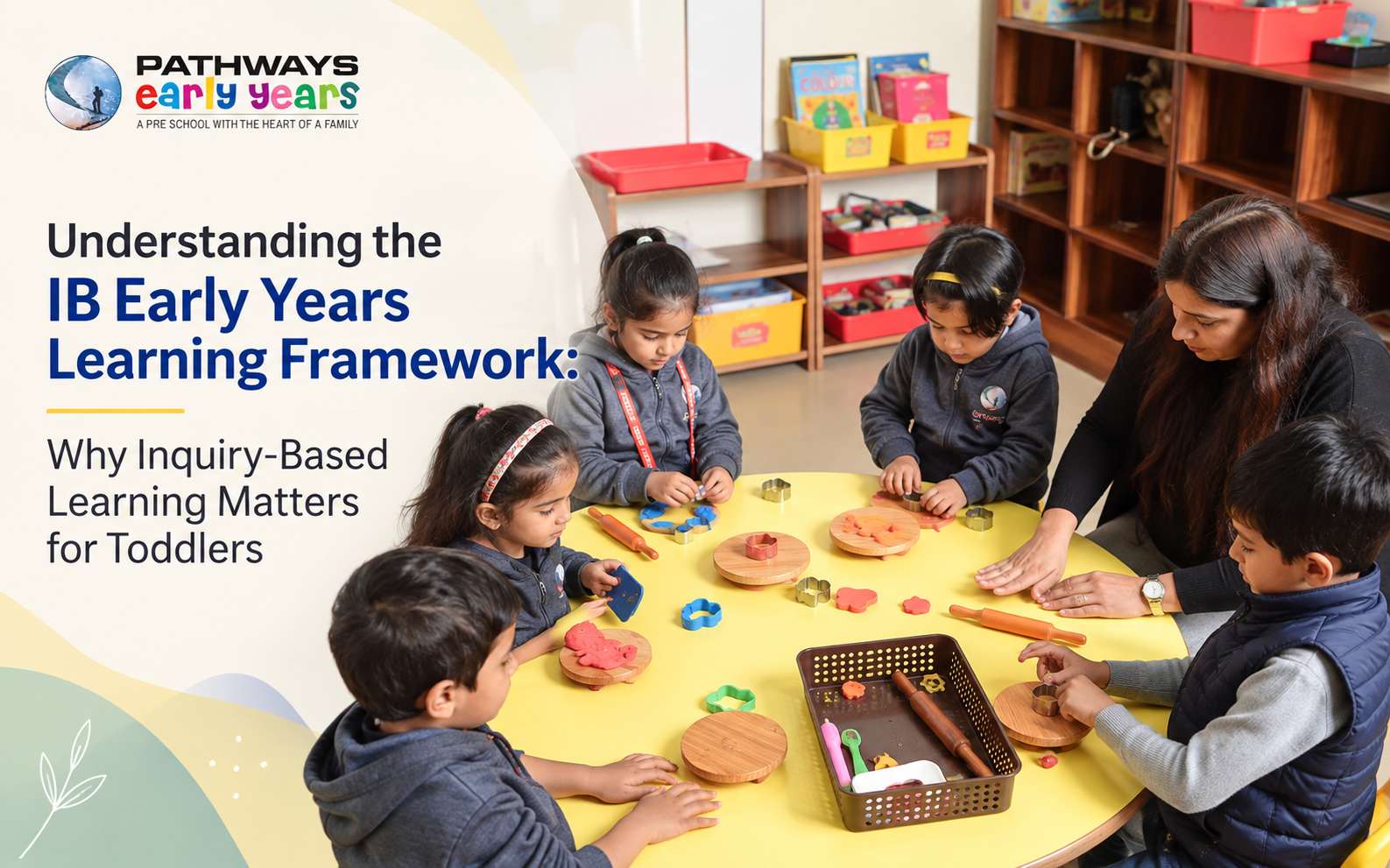
Inquiry-based learning for toddlers means children learn by asking questions, exploring real materials and testing ideas through play, guided by an educator. It is the core of the IB early years framework and builds thinking skills that rote memorisation cannot.
Your two-year-old just spent ten minutes dropping a spoon off the high chair to see if it falls the same way every time. That is inquiry-based learning for toddlers, and it started long before any school got involved. The question for parents on Golf Course Road is simple: which preschool builds on that instinct, and which one trains it out of a child with worksheets and repetition?
The IB early years programme was designed around that instinct. It replaces the "listen and repeat" model with a cycle of asking, exploring, testing and explaining, all through play. This guide covers what the framework is, the five stages and five E's of inquiry, real toddler-level examples, how it compares with rote learning, and what to check before you choose an inquiry-based preschool in Gurgaon.
Key Takeaways
• Inquiry is a method, not a mood: In the IB PYP early years curriculum, children move through a recognisable cycle of tuning in, finding out, sorting out, going further and taking action. Educators plan for it deliberately.
• Toddlers already inquire: Dropping, pouring, stacking and "why" questions are early inquiry. A good preschool extends these behaviours instead of scheduling them away.
• Play is the delivery system: Learning through play is how concepts such as change, cause and effect, and fairness are introduced between ages three and six.
• Rote memorisation has a short shelf life: Facts learnt without meaning fade quickly. Concept-based learning transfers to new situations and lasts.
• The proof is in the documentation: An inquiry-based preschool can show you the current unit of inquiry, the children's questions and photographs of the investigation. A brochure claim is not proof.
What is the IB early years learning framework?
The IB early years framework is the section of the Primary Years Programme (PYP) written for children aged three to six. It organises learning around play, relationships and purposefully designed spaces, so that children build big ideas through inquiry rather than through instruction delivered from the front of a room.
A few terms matter here, explained plainly:
• PYP: The Primary Years Programme, the IB's curriculum framework for ages three to twelve. The early years sit at the start of it.
• Transdisciplinary themes: Six broad themes that replace separate subjects. Maths, language, science and art all live inside each theme.
• Units of inquiry: Multi-week investigations planned under a theme, each with a central idea. In the early years, schools run at least four units a year, and two of them must always be "Who we are" and "How we express ourselves".
• Learner profile: Ten attributes such as inquirer, thinker, communicator and risk-taker, which describe the kind of person the programme hopes to grow.
The framework rests on four pillars. Play gives children long, uninterrupted time to choose and test. Relationships give them the security to take a learning risk. Learning spaces, indoors and out, are set up to provoke questions. Symbolic exploration, through drawing, building and pretend play, lets children represent ideas before formal writing begins.
If you are still deciding when to start, the guide on the right age for play school admission in Gurgaon covers readiness signs age by age.
The six transdisciplinary themes, translated for a toddler classroom
• Who we are: My body, my feelings, my family. Usually the first unit a three-year-old meets.
• Where we are in place and time: My home, my route to school, old photographs of the family.
• How we express ourselves: Music, dance, painting, story and role play as ways of showing an idea.
• How the world works: Water, light, shadows, magnets and weather. The home of most "why" questions.
• How we organise ourselves: Class jobs, shops, buses and rules. Why we have a snack helper and how a market works.
• Sharing the planet: Plants, pets, waste and fairness. Watering the class garden is an early version of this theme.
What is inquiry-based learning in preschool?
Inquiry-based learning in preschool is an approach where a child's own question or interest is the starting point, and the educator responds by setting up experiences that let the child investigate it. The teacher guides, observes and extends; the child does the thinking.
It is often confused with "free play with no plan". That is a misreading. In a genuine inquiry classroom the adult is highly intentional. She decides which materials appear on the table, which question to ask instead of answering, and when to introduce a new word or tool. Child-led learning describes who drives the direction, not who does the planning. The campus gallery shows what these deliberately prepared spaces look like in practice.
An example of inquiry-based learning in early childhood
A group of three-year-olds notices their shadows on the playground wall and starts trying to "catch" them. The educator does not explain light. She brings out torches, cardboard shapes and a white sheet the next morning. Over the week, children discover that shadows grow when the torch moves closer, that two torches make two shadows, and that a shadow disappears in the shade.
By Friday they have measured shadows with blocks, drawn them, invented a shadow-puppet story and told the two-year-old class how it works. Science, measurement, language, art and cooperation all happened, and nobody sat at a desk.
What are the 5 stages of inquiry-based learning?
The five stages most commonly used in early years settings are tuning in, finding out, sorting out, going further, and making conclusions and taking action. The stages describe how an investigation deepens, though toddlers rarely move through them in a neat straight line.
Here is how the same five stages play out with a ramp-and-cars investigation in a toddler room:
1. Tuning in: The educator sees several children lining up toy cars on a sloped book. She adds three ramps of different heights and simply watches what happens.
2. Finding out: Children race cars down each ramp. The teacher asks "What do you notice?" instead of explaining gravity.
3. Sorting out: Children draw their ramps, compare which car went furthest and start using words such as steeper, faster and further.
4. Going further: Someone asks whether a heavier car goes faster. New materials appear the next morning, including a wooden truck and a feather.
5. Making conclusions and taking action: The group builds a ramp in the outdoor area and teaches the younger class how to use it.
Every stage is visible to a parent. If a school tells you it follows inquiry but cannot describe where the current unit sits in this cycle, treat that as a warning sign.
What are the 5 E's of inquiry-based learning?
The 5 E's are Engage, Explore, Explain, Elaborate and Evaluate. It is a lesson-planning model that many IB early years educators use alongside the inquiry cycle to structure a single provocation or activity, rather than a whole unit.
For toddlers, the five E's look like this:
• Engage: Spark curiosity. A tray of ice cubes appears on the table with no instructions.
• Explore: Hands-on time. Children hold, drop, lick and watch the ice; the educator notes their comments.
• Explain: Children put words to what they saw. "It went to water!" The adult offers vocabulary such as melt and cold.
• Elaborate: Extend the idea. What happens to ice in the sun, in the fridge, wrapped in a cloth?
• Evaluate: Reflect. Children revisit photos from Monday and say what they now know. The educator records the change in thinking.
Notice that "Explain" comes from the child first, not the teacher. That order is the whole point of concept-based learning: understanding is built by the learner and then named by the adult, not the other way round.
Five examples of inquiry-based learning activities for toddlers
The best inquiry activities for toddlers use everyday materials, have no single right answer and can be repeated many times. These five work at home as well as in an inquiry-based preschool in Gurgaon, and each one maps to a transdisciplinary theme.
1. Sink or float (How the world works): A tub of water and a basket of objects. Ask "What do you think will happen?" before each drop. Let the child sort the objects afterwards.
2. Colour mixing (How we express ourselves): Three bottles of coloured water, droppers and clear cups. The question "How do we make orange?" keeps a two-year-old busy for half an hour.
3. Where does the rubbish go? (Sharing the planet): Sort the day's waste into bins with the child, then walk to see where it is collected. Follow whatever question comes next.
4. Build a shop (How we organise ourselves): Boxes, a toy till and handwritten price tags. Counting, early writing and turn-taking all emerge from the play.
5. Seed to sprout (Who we are / How the world works): Plant beans in a clear jar with wet cotton. Draw the jar every day. Children see change over time and learn to wait.
In each activity the adult's job is to ask, not tell. "I wonder why that one sank" does more for a toddler's thinking than a correct explanation ever will. The same open-ended provocations run through the daycare rooms, so a child who stays the full day keeps investigating rather than switching to screen time.
How is inquiry-based learning different from rote learning?
Rote learning asks a child to reproduce information; inquiry-based learning asks a child to construct it. One measures recall, the other builds reasoning. For a three-year-old, that difference sets the pattern for how they will meet every classroom for the next fifteen years.
The table below shows how play-based learning vs rote learning looks in the areas parents notice on a school visit.
Aspect | Traditional rote-learning preschool | IB early years (inquiry-based) |
Starting point | A fixed syllabus, identical for every child | The children's questions, interests and existing ideas |
Educator's role | Instructor delivering content | Co-researcher who observes, provokes and guides |
Place of play | A break between lessons | The main mode of learning |
Typical morning | Tracing letters, chanting rhymes, colouring inside lines | Investigating one question with real materials, then documenting it |
What is assessed | Recall and neat copying | Understanding, skills and learner-profile dispositions |
Mistakes | Corrected immediately | Treated as the next question |
Parent feedback | Star charts or grades | Learning stories with photographs and observations |
By age six | Knows many answers | Knows how to find answers and explain the thinking |
One clarification parents often need: inquiry does not skip letters and numbers. Literacy and numeracy are built into the investigations. Children running a pretend shop write price tags, count coins and read signs because the play requires it. The skills are the same as in a rote classroom; the reason for learning them is completely different.
How does the IB learner profile show up in a toddler classroom?
The IB learner profile attributes are practised through daily routines in the early years, not taught as vocabulary. A child who makes space at the sand tray is being caring. A child who climbs the frame again after slipping is being a risk-taker.
Grouped for a toddler room, the ten attributes look like this:
• Inquirers and thinkers: Asking "why", predicting, and changing an idea after testing it.
• Communicators: Explaining a drawing, retelling a story with props, saying "I don't like that" to a friend.
• Principled and caring: Waiting for a turn, noticing that someone is upset, feeding the class fish unprompted.
• Open-minded and balanced: Tasting an unfamiliar snack, moving between quiet and active play without a fuss.
• Risk-takers and reflective: Trying a harder puzzle, looking at yesterday's block tower and deciding what to change.
• Knowledgeable: Understanding a topic well enough to explain it to a younger child.
Underneath all ten sits learner agency in early childhood: voice, choice and ownership. A three-year-old who spends the whole morning on one investigation is not "off task". She is doing exactly what the framework was written to protect. For older children, the afterschool programme carries the same balance of choice and structure into the later afternoon.
What should Gurgaon parents check before choosing an inquiry-based preschool?
Check for evidence that inquiry is practised, not just printed. Ask what the children are currently investigating, how that learning is documented and how much uninterrupted play a child gets each day. The answers reveal the model faster than any tour.
Many schools along Golf Course Road describe themselves as international or play-based. Seven questions separate the label from the practice:
1. "What is the current unit of inquiry?" A real answer names a theme and a central idea.
2. "Can I see how learning is documented?" Expect photographs, observations and children's work, not stickers.
3. "How long is the longest block of uninterrupted play?" Look for an hour or more, not twenty minutes between activities.
4. "What happens when a child asks something you did not plan for?" This reveals whether the teacher follows the child or the timetable.
5. "How are reading and numbers taught?" The right answer describes how they emerge inside inquiry.
6. "How do you share progress with parents?" Learning stories and regular conversations beat termly grades.
7. "What can children do outdoors?" Digging, water, loose parts and climbing signal a real early years environment.
Why choose Pathways Early Years GCR for the IB early years programme?
An international preschool on Golf Course Road should be judged on the daily environment as much as the philosophy. Here is what families in and around GCR find at Pathways Early Years, Sector 55:
1. Inquiry from the toddler stage: The PYP early years approach shapes the classroom from a child's first day, so there is no rote habit to unlearn later.
2. Spaces built for young investigators: Indoor and outdoor areas with materials at child height and room to build, pour and get messy.
3. Continuity across the whole day: Preschool, daycare and afterschool care run under one roof, with the same educators and the same approach across the whole day.
4. Educators as co-researchers: Teachers plan provocations, observe closely and document thinking instead of delivering a fixed syllabus.
5. Documentation you can actually read: Learning stories with photographs and observations show what your child explored and how their ideas changed.
6. Close for Golf Course Road families: Sector 55 is a short drive from Sectors 54 to 57, DLF Phase 5, Sushant Lok and Golf Course Extension Road.
Curiosity Is the Curriculum
Every toddler already knows how to inquire. They ask, pour, drop, break and rebuild without instruction. The IB early years framework does not invent that curiosity. It protects it, gives it structure and turns it into the habit of thinking that carries a child through school and well beyond.
Rote memorisation can produce a three-year-old who recites capitals at a dinner party. Inquiry produces a six-year-old who asks why capitals exist and then finds out. For parents weighing premium early education on Golf Course Road, that is the difference worth choosing.
See inquiry-based learning in action Spend a morning at Pathways Early Years GCR in Sector 55, Gurugram, and watch how toddlers learn when nobody hands them a worksheet. Book a campus visit or request a call-back through the enquiry form on the preschool in GCR page. Admissions are open for the current session. |
About the Author
Pathways Early Years
Frequently Asked Questions
The IB defines the early years as ages three to six inside the Primary Years Programme. Preschools that follow the framework usually apply the same inquiry principles in their toddler groups, so children enter the formal early years band already used to learning through play.
Yes, when it is scaled to the child. For a two-year-old, inquiry means sensory exploration, simple cause-and-effect play and an adult who responds to what the child is curious about. Nobody expects a toddler to sit through a "unit". The environment simply invites questions.
A traditional preschool follows a set syllabus with teacher-led lessons and recall-based activities. An IB early years classroom starts from children's questions, uses play as the main way of learning and assesses understanding rather than memorisation. Because the goals differ, the daily experience differs too.
Three-year-olds in a PYP early years setting build language through rich play, learn to ask and test questions, and practise self-regulation in a low-pressure environment. They also develop the learner profile attributes, such as being caring and reflective, through daily routines rather than lessons.
It does, but within meaningful contexts. Children meet print by making signs for a block city, writing shopping lists in the role-play corner and reading familiar stories. Phonics and number sense are introduced as a child shows readiness, not on a fixed date.
Through observation and documentation, not tests. Educators collect photographs, notes, work samples and the child's own reflections into learning stories. These show growth in understanding, skills and dispositions, and are shared with parents regularly.
Children from inquiry-based settings usually enter formal school with strong language, confidence in asking questions and the ability to work both independently and in a group. Those are the habits Grade 1 teachers value most. Any school-specific readiness skills are covered inside the programme.
Answer a "why" with "what do you think?" before giving the answer. Keep open-ended materials such as boxes, blocks, water and paper within reach. Let your child finish an investigation instead of moving them on, and talk about what they noticed rather than whether they were right.
Get in Touch
Still have questions? Fill out the form below and our team will get back to you shortly.