
Overcoming Toddler Separation Anxiety: Practical Tips for a Smooth Preschool Transition
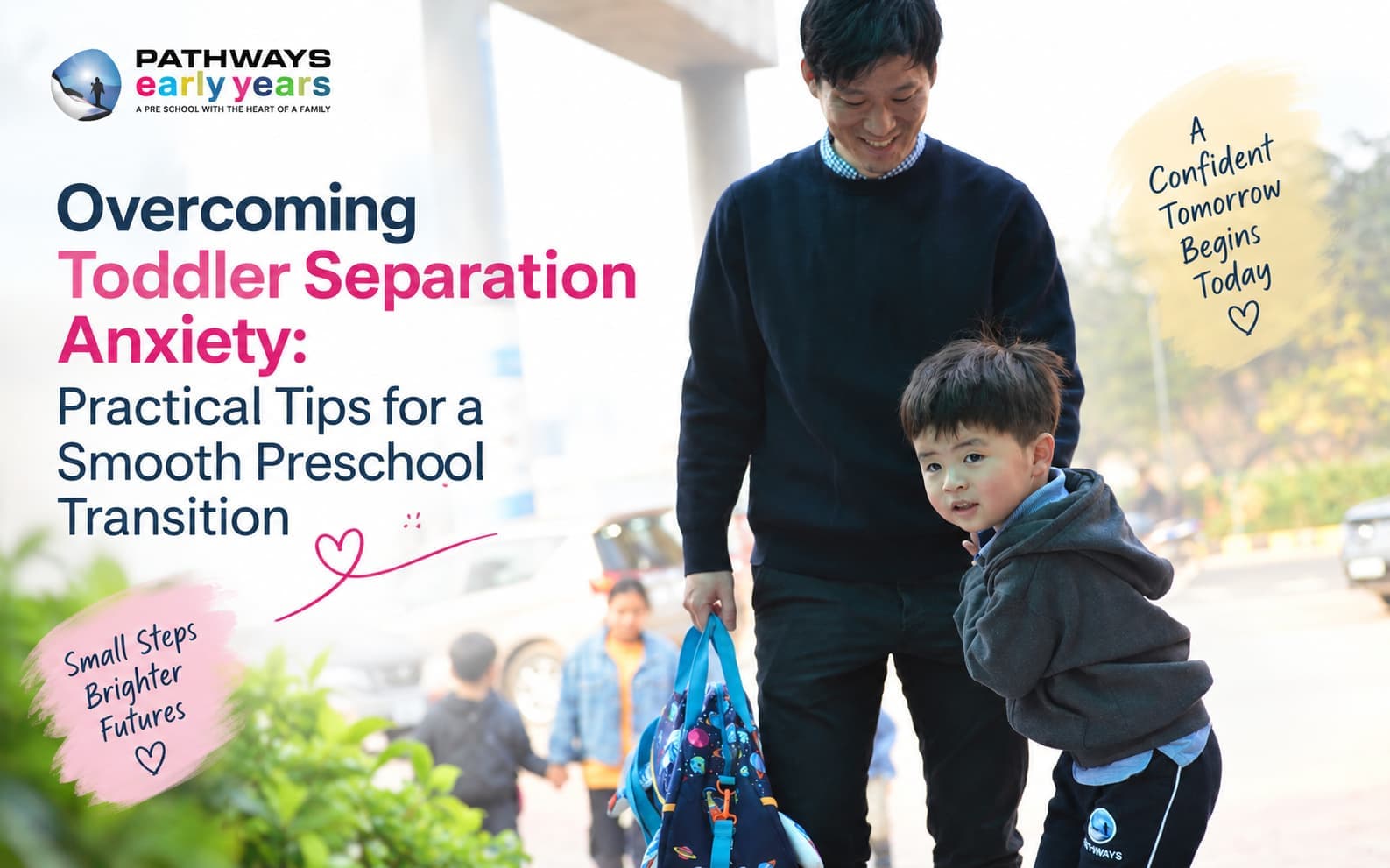
Toddler separation anxiety at preschool is a normal sign of secure attachment and usually eases within two to four weeks. Predictable routines, a short goodbye ritual, a comfort object and a gradual settling-in plan make the transition smoother.
Toddler separation anxiety at preschool is the distress a young child shows when a parent leaves them in a new setting. It is a normal sign of secure attachment, not a problem with the child or the school, and with a consistent routine, a short goodbye ritual and a gradual settling-in plan, most children adjust within two to four weeks.
This guide is written for working parents in Gurgaon who want the transition handled well, not just endured. It explains why the tears happen, what the first month usually looks like, how to prepare at home, exactly what to do at the door, and what a supportive early years campus should be doing on its side.
At a glance Who it affects: most children between 18 months and 4 years, especially in the first month of preschool. How long it lasts: typically two to four weeks of consistent attendance; the second week is usually the hardest. What works: a fixed morning routine, a 60-second goodbye ritual that never changes, a small comfort object, and a school that staggers separation over the first weeks. |
Why do toddlers experience separation anxiety at preschool?
Toddlers experience separation anxiety because their brain has learnt that you exist even when you are out of sight, but has not yet learnt that you reliably come back. That gap between "Mum is gone" and "Mum returns" is where the fear lives. Preschool makes the gap longer and the setting unfamiliar, so the fear gets louder.
Two ideas from developmental psychology explain most of what you see at the door:
• Object permanence: Around eight to twelve months, children understand that people and objects continue to exist when hidden. Before this, out of sight really was out of mind. After it, a parent leaving becomes something to protest.
• Secure attachment: John Bowlby's attachment theory describes how a child uses a trusted adult as a "secure base" from which to explore. A toddler who cries when that base leaves is showing a healthy bond. Children who show no reaction at all are the ones educators watch more closely.
So the crying is not weakness, and it is not manipulation. It is a toddler saying, in the only language available, "You matter and I am not sure this new place is safe yet." The job of the next few weeks is to prove that it is.
What are the signs of preschool separation anxiety in the first 30 days?
Preschool separation anxiety usually moves through three rough phases in the first month: protest, hesitation and settling. Each phase has its own behaviours, and knowing the sequence stops parents from panicking on day nine when things briefly look worse than day two.
Phase 1: Protest (roughly days 1 to 7)
Loud tears at drop-off, clinging, refusing to walk in, sometimes crying for ten to twenty minutes after you leave. Educators expect this. Many children calm within minutes of the parent being out of view, even when the goodbye itself was dramatic.
Phase 2: Hesitation (roughly days 8 to 15)
The novelty has worn off and the child now knows drop-off is coming. Morning resistance often peaks here: slow dressing, "tummy ache", tears in the car. At school, the child may play but stay near the educator. This is the phase where parents most often wobble and skip a day, which resets progress.
Phase 3: Settling (roughly days 16 to 30)
Goodbyes shorten, the child starts naming friends and activities, and drop-off becomes a routine rather than an event. Some children still cry briefly, then recover fast. That fast recovery is the real marker of adjustment, not the absence of tears.
Across all three phases, look out for spill-over at home: regression in toilet training, appetite changes, bedtime resistance or extra clinginess in the evening. These are normal responses to a big change and usually fade as the school routine settles. If they intensify beyond six to eight weeks, speak with your paediatrician.
How do you prepare a toddler for play school two to three weeks before day one?
Prepare a toddler for play school by making the school day predictable before it starts: fix the sleep and morning routine, talk about school in concrete terms, practise short separations and visit the campus together. Familiarity is the single biggest reducer of first-week distress.
A practical countdown for the fortnight before:
1. Lock the sleep schedule first. A toddler who is short on sleep has no reserves for a hard morning. Move bedtime and wake-up to school timings at least ten days out.
2. Run the real morning routine. Same wake, wash, dress, breakfast and leave-the-house sequence you will use on day one, even on days you are not going anywhere.
3. Read about school every day. Picture books about a child going to preschool and coming home again make the return part of the story, not just the leaving.
4. Play "school" at home. Set out a snack, sing a circle-time song, then pretend a parent leaves and comes back. Let your child play the teacher too.
5. Practise short goodbyes. Leave your child with a grandparent or trusted adult for 30 minutes, then an hour, always saying goodbye clearly and always returning when you said you would.
6. Visit the campus together. Meet the educator, find the child's cubby, use the toilet, see the garden. On day one nothing should be completely new.
Before any of this, it is worth checking that the timing itself is right. Our guide on the right age for play school admission covers the readiness signs, because a child who is not yet ready will struggle no matter how good the preparation is.
What should you do at drop-off to prevent tears?
At drop-off, keep the goodbye short, warm and identical every day, hand your child to the same educator, and leave without sneaking away. Lingering and disappearing both make the next morning harder; a brief, confident goodbye ritual makes it easier.
The 60-second goodbye ritual
The most reliable pattern is kiss, affirm, go. A hug or kiss, one calm sentence ("I love you, Ms Riya will look after you, I'll be back after snack"), then leave. Sixty seconds, no negotiation, no second goodbye from the window. It feels abrupt to parents; to toddlers it feels safe because it is the same every time.
Two habits that feel kind but backfire:
• Lingering: Staying "until they settle" teaches the child that crying keeps you there. The tears get longer, not shorter.
• Sneaking out: Slipping away while the child is distracted avoids one hard moment and creates a bigger one. The child learns that you can vanish at any time, so they stop letting you out of sight at all.
The transitional object technique
A small object that carries a piece of home into school gives a toddler something to hold when the feeling comes. Good options are a handkerchief that smells of a parent, a matching wristband that both of you wear, or a heart drawn on the back of the hand to "press when you miss me". Keep it small, safe and allowed by the school.
Consistency across every caregiver
If Mum does a 60-second goodbye, Dad does a ten-minute one and the nanny sneaks out, the child experiences three different rules and trusts none of them. Agree the ritual as a household, write it on the fridge if needed, and brief grandparents before they cover a drop-off.
What makes an early years campus supportive during settling in?
A supportive early years campus runs a progressive settling-in plan, assigns one consistent educator to each new child, keeps groups small enough for that educator to actually respond, and updates parents during the day. Ask about all four before you enrol, because the school's side of the transition matters as much as yours.
Here is what good practice looks like in each area:
• Progressive separation: Day one might be 30 to 45 minutes with a parent in the room. Over one to two weeks, the parent moves to the corridor, then the gate, then home, while the child's hours stretch to a full session.
• A key educator: One adult greets the child every morning, takes the handover and is the person the child looks for. Rotating staff during the settling-in period resets trust each day.
• Educators who name feelings: "You are sad because Papa left. He is coming back after snack. Let's go and see the water tray" is the script. Distraction alone does not teach a child that the feeling is manageable.
• Curiosity as the bridge: A classroom built on an inquiry-based early learning framework gives a distressed toddler something worth turning towards. A provocation on the table, a question from a friend, a bean sprouting in a jar. Engagement is what eventually replaces the tears, and it has to be real.
• Transparent updates: A photo or short note during the first weeks tells a parent at a desk in Cyber City that the crying stopped at 9:12. That single message does more for parental guilt than any reassurance at pick-up.
If you are still deciding between care setups for a full working day, the daycare vs preschool comparison explains how the settling-in approach differs between the two and which suits a child who separates slowly.
Effective parent behaviours vs common pitfalls
The same situation can build confidence or escalate distress depending on the parent's response. This table covers the four moments where the difference shows most.
Parenting scenario | What causes escalation (avoid) | What builds confidence (do) |
The goodbye | Lingering, repeated hugs, checking through the window, sneaking away | One warm ritual, same words every day, a clear "I'll be back after snack", then leave |
Handling tears | "Don't cry, big boys don't cry", bribing with a toy, looking anxious yourself | Name the feeling ("You're sad, that's okay"), stay calm, hand over to the educator with confidence |
Post-school debrief | "Did you cry today? Were you good?" Interrogating the hard parts | "What did you play with? Who sat next to you at snack?" Ask about the good parts and let the child lead |
Weekend and holiday disruption | Late nights, no routine, then a shock Monday | Keep wake and bedtime close to school hours; on Sunday, talk about Monday in concrete, cheerful terms |
A bad morning | Skipping school "just today" | Go anyway, keep the ritual, tell the educator it was a rough start so they can support |
How do working parents handle drop-off guilt in corporate Gurgaon?
Working parents handle drop-off guilt by separating the feeling from the facts: the child's tears are about the moment of leaving, not the hours that follow. A school that shows you those hours, through updates and honest conversations, turns guilt into information you can act on.
The guilt is real and it is heavier when the commute is long. A parent driving from Golf Course Road to Cyber City or Horizon Center, or logging into a 9:30 call from the car, has no way of knowing what happened after the gate closed. That uncertainty is what the guilt feeds on. A few things that help:
• Ask for the timing, not just the outcome. "She settled" is reassuring. "She stopped crying at 9:08 and spent the morning at the sand table" is evidence. Schools that share the second kind of detail are worth their fees.
• Plan the reconnection. Fifteen minutes of full attention at pick-up or bedtime, phone away, matters more to a toddler than the number of hours apart.
• Do not apologise to your child for working. Toddlers read your emotional state. If you treat school as a loss, they will too. Treat it as their place, and they will start to own it.
• Give it the full month. Most parents who pull a child out do so in week two, at the hardest point of the curve, just before it turns.
When you are comparing local options, our guide on how to choose the best preschool includes a checklist of settling-in questions to ask on every campus tour, so you can judge the transition support before you commit.
Why choose Pathways Early Years GCR for a gentle start?
Families around Golf Course Road, DLF Phase 5 and Sectors 42 to 54 choose Pathways Early Years, Sector 55, because the settling-in period is treated as part of the programme, not a hurdle to get past. Specifically:
1. A gradual settling-in plan: Separation is staged over the first weeks, with parents welcomed in the room at the start and stepping back as the child is ready.
2. One familiar face every morning: A consistent educator takes each new child's handover so the door is never a surprise.
3. Something worth walking in for: Inquiry-led classrooms give toddlers a real reason to turn from the door to the table, which is where adjustment actually happens.
4. Updates for parents at work: Families hear how the morning went, so a hard goodbye at 8:45 does not become a hard day at the office.
5. A campus built for young children: Calm indoor spaces and an outdoor area that draws children in on their most reluctant mornings.
6. Close to home and to work routes: Sector 55 sits minutes from Golf Course Road and the main routes towards Cyber City and Golf Course Extension.
Embracing the Transition with Confidence
Separation anxiety is not a sign that preschool is wrong for your child. It is a sign that your child loves you and has not yet learnt that this new place is safe. Teaching that lesson takes a predictable routine at home, a short and steady goodbye at the door, and a school that meets the child with patience and something interesting to do.
Handled as a partnership between parents and educators, the tears fade in weeks and leave behind a child who knows they can be brave in a new place. That confidence is the first real thing preschool teaches, and it is worth the hard mornings.
See how settling in works, before you decide Book an experiential walkthrough at the best preschool on Golf Course Road Gurgaon and watch a morning handover for yourself. Meet the educators, see the settling-in plan and ask every question on your list. Visit Pathways Early Years GCR, Sector 55, Gurugram, or request a call-back through the website enquiry form. |
About the Author
Pathways Early Years
Frequently Asked Questions
Most toddlers settle within two to four weeks of consistent attendance, with the hardest stretch usually in the second week. Some children take six to eight weeks, especially if attendance is irregular or the goodbye keeps changing. If distress is still intense after two months, talk to the educator and your paediatrician together.
No. Sneaking away avoids one hard moment but teaches the child that you can disappear without warning, which makes them more watchful and clingy the next day. A short, clear goodbye is harder for a minute and far easier over the month, because the child learns that leaving is announced and returning is guaranteed.
Only as part of a planned settling-in schedule agreed with the school, where your presence reduces day by day. Staying unpredictably, or coming back after leaving, tells the child that crying brings you back. Trust the educator: most children who are inconsolable with a parent present calm within minutes once the parent has gone.
Yes, and it is very common. A Diwali break or even a long weekend can bring back tears that had disappeared. Keep sleep and mealtimes close to school hours during the break, talk about school positively the day before returning, and use the exact same goodbye ritual. The second settling-in is almost always shorter than the first.
This usually means the goodbye differs between parents, or the child has learnt that one parent can be persuaded to stay. Agree one ritual with identical words and timing, and have the parent who gets fewer tears do drop-off for a week while the other practises the same script at home. Consistency usually resolves it.
Not on its own. Intensity of crying is a poor measure of readiness; how quickly a child recovers after you leave is a better one. A child who calms within fifteen minutes and engages with play is ready. A child who cannot settle at all across several weeks, despite a consistent plan, may benefit from a later start or shorter sessions.
A good educator stays close, names the feeling in simple words, offers physical comfort if the child accepts it, and then gently guides the child towards an activity rather than trying to talk them out of the tears. They also tell the parent honestly how long it took, because that information helps the family adjust the plan at home.
Give the first fifteen minutes after pick-up or after you get home fully to the child: phone away, sit at their level, follow their lead. Ask about the good parts of the day rather than the tears. A predictable evening routine with a shared story at bedtime does more for reconnection than an extra hour of distracted time.
Get in Touch
Still have questions? Fill out the form below and our team will get back to you shortly.