
Daycare vs. Preschool: Which is the Right Choice for Your Child in Gurgaon?
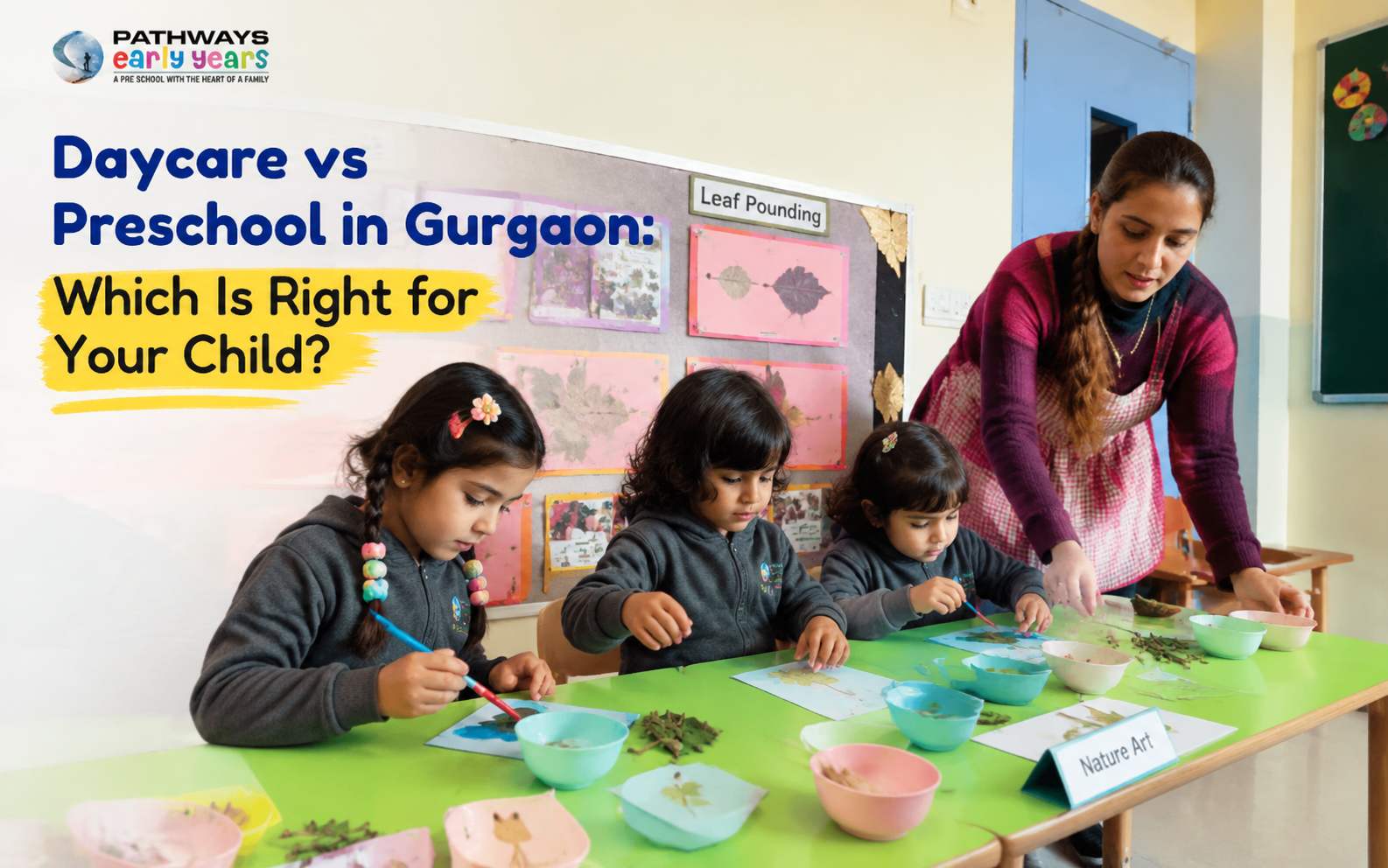
Daycare keeps your child safe for long hours; preschool builds school readiness through a structured curriculum. Here is how Gurgaon parents can pick the right fit by age, work hours and learning goals.
daycare gives your child safe, supervised care for long hours, while preschool gives a structured curriculum that builds school readiness. If your child is between 2 and 4, preschool is usually the better choice for learning. If you need coverage till evening, look for a preschool that also offers extended-day care.
Many parents in Gurgaon find this decision confusing because the two options overlap. Some daycares now run activity sessions, and some preschools stay open till 6 pm. Add a demanding work schedule, a long commute on Golf Course Road, and grandparents who may not be nearby, and the choice becomes harder than it should be. This guide clears it up.
Quick answer: Choose preschool for a structured curriculum and nursery readiness between ages 2 and 4. Choose daycare, or a preschool with extended day, if you need full-day childcare for working parents.
Key Takeaways
• Purpose is the real difference: daycare is built around care and hours, preschool is built around learning and routine.
• Age decides a lot: under 2, care matters most; from 2 to 2.5 years, structured preschool learning starts to pay off.
• Working parents in Gurgaon rarely have to choose: many preschools now offer extended-day care that covers both needs.
• Ask about the afternoon: what happens after 1 pm tells you whether a centre is truly educational or just supervising.
• Nursery admission at 4 years (as on 31 March) is the deadline most Gurgaon families are working towards, so plan backwards from it.
What is a daycare?
A daycare is a childcare centre in Gurgaon that looks after your child while you are at work. The focus is safety, meals, naps and supervised play, usually for long hours.
Most daycares in Gurgaon open early, around 8 am, and stay open till 6 pm or 7 pm. They accept children from as young as 6 months up to 6 or 8 years, and some run after-school care for older kids too. Staff are caregivers first, and while many centres do run stories, songs and craft time, there is usually no fixed learning plan tied to age-wise milestones.
Daycare is the right answer when your main need is reliable full-day childcare and you want your child to be safe, fed, rested and happy while you work.
What is a preschool?
A preschool, also called a play school in Gurgaon, is an early childhood education setting for children roughly 1.5 to 5 years old. The focus is learning through play, guided by a structured curriculum.
A typical preschool in Gurgaon runs a morning session of about three to four hours, often starting between 8:30 am and 9:30 am. Each day follows a routine: circle time, language and number activities, outdoor play, music, snack time and story time. Teachers are trained in early years education and track your child's progress across language, motor skills, social behaviour and independence.
Preschool is designed to build school readiness. That simply means your child gets used to sitting for short activities, following instructions, taking turns and being away from you for a few hours, all before nursery begins.
Daycare vs preschool: key differences
Here is the difference between daycare and preschool at a glance, based on what you will typically find in Gurgaon.
Factor | Daycare | Preschool |
Primary purpose | Safe, supervised care while parents work | Early learning and school readiness |
Age group | 6 months to 6 or 8 years | 1.5 to 5 years |
Hours | Full day, often 8 am to 7 pm | Half day, about 3 to 4 hours; extended day available at many centres |
Curriculum | Free play with some activities; no fixed learning plan | Structured, age-wise curriculum with daily routine |
Teacher-to-child ratio | Varies widely; often higher per caregiver | Typically 1:8 to 1:12, lower for toddlers |
Learning outcomes | Social exposure, comfort with routine | Language, early numeracy, motor skills, independence |
Cost pattern in Gurgaon | Charged by hours or full-day slot; can be higher for long hours | Charged per term or year; extended day adds a separate fee |
The biggest difference is purpose. Daycare exists so parents can work; preschool exists so children can learn. Everything else, from hours to staffing, flows from that.
Hours are the second big gap. A preschool session ends by early afternoon, which does not work for a parent whose day ends at 6 pm. That is exactly why so many parents in Gurgaon end up looking at extended-day preschool options, which we cover below.
Curriculum quality is where the two options overlap the least. A good preschool plans every day around what a 2 year old or 3 year old should be learning. A daycare may offer activities, but they are rarely sequenced or tracked against milestones.
Finally, the teacher-to-child ratio matters more than most parents realise. A lower ratio means your child gets more attention, more conversation and faster help when upset. Ask for the exact number at every centre you visit.
Which is better for a 2 year old vs a 3 year old?
For a 2 year old, a play-based preschool toddler programme is usually better than a supervision-only daycare. For a 3 year old, preschool is clearly the better choice, because this is the year that decides how ready your child is for nursery.
If your child is around 2 years old
At 2, your child is learning to talk, to play alongside other children and to manage short separations from you. A good toddler programme at a preschool gives all three in a gentle two-to-three hour session. If you need longer hours, a daycare with guided activities works, but check that the afternoon is not just screen time and naps.
If your child is around 3 years old
At 3, children are ready for a fuller routine. They can sit for a 15-minute activity, follow two-step instructions and enjoy group games. This is the ideal age to start preschool in Gurgaon if you have not already, because nursery admission at 4 is only a year away. A structured curriculum now makes that transition far smoother.
Not sure whether your child is ready yet? Our guide on the right age to start preschool in Gurgaon walks through the age cut-offs and readiness signs in detail.
Daycare vs preschool for working parents in Gurgaon
For working parents in Gurgaon, the real problem is not daycare versus preschool. It is hours. Both parents are usually out from 9 am to 7 pm, and a three-hour preschool session leaves a gap of five or six hours.
Parents typically solve this in one of three ways. Some hire a nanny for the afternoon, which is expensive and inconsistent. Some pick a daycare for the full day and accept less structured learning. A growing number choose a preschool with extended-day care, so the child stays at one place, with familiar teachers, from morning to evening.
Before choosing any full-day option, ask these questions:
• What time is the last pick-up, and what happens if I am late because of traffic?
• Is the centre open during school holidays and long weekends?
• What does the afternoon schedule look like, hour by hour?
• Who is with my child after the morning teachers leave, and what is their training?
• How will I get daily updates on meals, naps and mood?
The answers will quickly tell you whether a centre is set up for working parents childcare or simply tolerates it.
Can a preschool offer both?
Yes. A preschool with an extended-day programme combines a structured morning curriculum with supervised afternoon care, giving working parents full-day childcare without giving up on learning.
This model is now common in Gurgaon, especially around Golf Course Road, Sushant Lok and Sectors 42 to 56, where many dual-income families live. The morning follows the regular preschool routine. After lunch, children rest, then move into lighter guided activities such as reading corners, free art and outdoor play, until pick-up in the evening.
At Pathways Early Years, Golf Course Road, the day is built around exactly this idea: children grow through games, stories and creative activities with caring teachers, and families who need longer hours can ask about extended-day support. If you are comparing options in the area, a campus visit is the fastest way to see how the morning and afternoon actually feel.
How to decide: a 5-question checklist for Gurgaon parents
Use these five questions to make the daycare vs preschool decision in under ten minutes.
1. How old is my child? Under 2: prioritise care and ratio. Between 2 and 4: prioritise a structured curriculum.
2. How many hours do I really need? Add commute time. If it is more than four hours a day, you need daycare or extended-day preschool.
3. What happens after 1 pm? If the centre cannot describe a clear afternoon routine, it is supervision, not learning.
4. What is the teacher-to-child ratio for my child's age? Get a number, not a reassurance.
5. When is nursery admission? If your child turns 4 by 31 March next year, choose the option that best builds school readiness now.
For a deeper look at facilities, safety and curriculum quality, read our guide on how to choose the best preschool in Gurgaon.
Conclusion
When it comes to daycare vs preschool in Gurgaon, the answer depends on two things: your child's age and your working hours. Daycare solves the hours problem. Preschool solves the learning problem. Between ages 2 and 4, learning should lead, and a preschool with extended-day care lets you have both without compromise.
Whichever you choose, visit the centre, watch a session, and ask about the afternoon. Your child will spend more waking hours there than almost anywhere else, so the routine, the ratio and the warmth of the teachers matter more than the label.
Ready to see an early years programme in action? Book a campus tour with Pathways Early Years on Golf Course Road, or call +91 9717755998 to speak with the admissions team. You can also explore more parenting guides on our blog.
About the Author
Pathways Early Years
Frequently Asked Questions
For most 2 year olds in Gurgaon, a preschool toddler programme with a gentle, play-based routine is the better fit. At this age, children benefit from short structured sessions, language-rich play and social time with peers. Daycare works well if you need longer hours, provided the centre offers guided activities and not just supervision.
Most Gurgaon preschools admit children from 18 months to 2.5 years for toddler or playgroup, around 3 years for pre-nursery, and 4 years for nursery, with the age counted as on 31 March of the admission year. Readiness matters as much as age, so look at your child's comfort with separation and routine.
A basic daycare that only supervises children is not enough for early learning between ages 2 and 4. Children in this window need planned language, motor and social activities every day. A daycare that follows a preschool curriculum, or a preschool with extended-day care, covers both safety and learning.
Yes. Many preschools on Golf Course Road and nearby sectors now run an extended-day option, so your child attends the regular preschool session and then stays for supervised care until evening. This is the closest thing to a daycare with a preschool curriculum in Gurgaon, and it keeps teachers and routines consistent through the day.
Preschool sessions in Gurgaon usually run for about three to four hours in the morning, typically starting between 8:30 am and 9:30 am. Daycare and extended-day care commonly run until 5 pm to 7 pm. Always confirm pick-up cut-off times and late-pickup rules before you enrol.
Check five things: total hours covered including holidays, the teacher-to-child ratio, whether the afternoon has planned activities or just free time, safety measures like CCTV and verified pick-up, and how the centre communicates daily updates. A preschool with extended day often ticks all five for dual-income families.
Yes. Preschool builds the habits that nursery interviews and classrooms expect, such as sitting for short activities, following instructions, sharing, and basic language skills. Children who attend a structured preschool from around age 2.5 usually settle into nursery faster than children who only attended a supervision-based daycare.
If your child is under 2, the decision is mostly about care and gentle stimulation rather than academics. Choose a daycare or toddler programme with a low ratio, warm caregivers and a predictable routine. You can move to a preschool programme closer to 2 to 2.5 years, when structured group learning starts to pay off.
Get in Touch
Still have questions? Fill out the form below and our team will get back to you shortly.