
Kindergarten Readiness Checklist: Essential Developmental Milestones for 4-Year-Olds
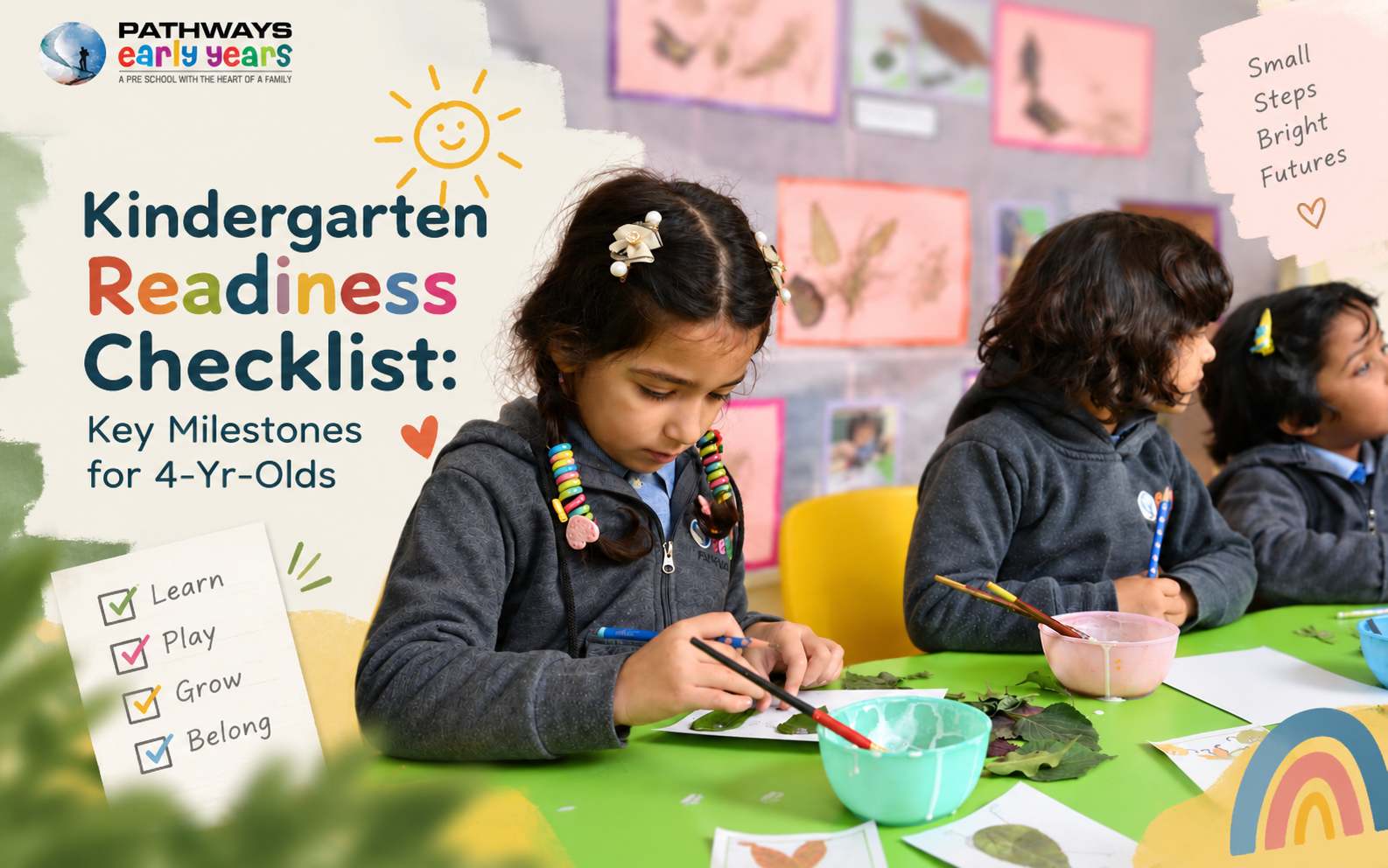
A practical kindergarten readiness checklist for 4-year-olds covering social-emotional, language, cognitive, and motor milestones, helping Gurgaon parents evaluate true school readiness before Grade 1 admissions.
A 4-year-old is kindergarten-ready when four pillars come together: Cognitive (curiosity, pattern recognition, early numeracy), Social-Emotional (separation confidence, sharing, self-regulation), Language (multi-sentence expression, phonemic awareness), and Motor Skills (pencil grasp, independent hygiene, balance). No single milestone matters more than the whole picture.
If you're a working parent in Golf Course Road or DLF Phase 5, chances are the kindergarten readiness question has been sitting at the back of your mind for a while now. You watch your four-year-old build an elaborate block tower, narrate an entire imaginary story to their stuffed animals, and then refuse to sit still for two minutes at the dinner table. You wonder: is this normal, or is this a gap I need to close before Grade 1?
This kindergarten readiness checklist for 4 year olds is built to answer exactly that. No guilt, no pressure, and no turning your child's last year of early childhood into a worksheet marathon — just a clear sense of what to look for, whether you're assessing your child at home or evaluating the best kindergarten school on golf course road gurgaon for admission.
Kindergarten vs. Nursery: Understanding the Developmental Shift
Nursery is exploratory. Children move between sensory corners, follow their own pace, and learn primarily through unstructured play. Kindergarten asks for something more: sustained attention, group participation, and the beginnings of independent problem-solving.
This shift isn't just about knowing more words or numbers. It's a leap in executive functioning: the ability to hold instructions in mind, switch between tasks, and manage impulses long enough to finish an activity. A child who can recite numbers to twenty but cannot match five objects to the number five hasn't built number sense.
The Comprehensive Kindergarten Readiness Checklist (By Domain)
Use this as a reference, not a scorecard. Children rarely tick every box at the same time, and that's expected.
1. Social-Emotional Milestones & Self-Regulation
● Separates from a parent or caregiver without prolonged distress
● Shares materials or takes turns with minimal adult prompting
● Names basic emotions (happy, frustrated, sad, excited) and begins to self-soothe
● Listens to and follows a two-step instruction in a group setting
● Shows early empathy, such as comforting a crying classmate
2. Language, Literacy & Phonemic Awareness
● Expresses multi-sentence thoughts rather than single-word answers
● Recognizes the beginning sounds of familiar words (phonemic awareness)
● Retells a simple story with a beginning, middle, and end
● Asks "why" and "how" questions to build understanding, not just facts
● Holds a two-way conversation with an adult outside the family
3. Cognitive Thinking & Early Numeracy
● Recognizes and extends simple patterns (colour, shape, sound)
● Demonstrates one-to-one number correspondence up to ten
● Sorts objects by more than one attribute (colour and size together)
● Shows curiosity-driven inquiry: asking questions, testing ideas, observing outcomes
● Understands basic positional language (under, behind, between)
4. Physical & Fine Motor Development
● Holds a pencil using a pincer or near-tripod grasp
● Uses child-safe scissors to cut along a line
● Manages independent bathroom hygiene and handwashing
● Balances on one foot for a few seconds and navigates stairs with alternating feet
● Buttons a shirt or zips a jacket with minimal help
The Myth of Academic Over-Drilling vs. True School Readiness
There's a common assumption among Gurgaon's corporate parents that more worksheets equal more readiness. In practice, the opposite tends to be true. Mechanical drilling, where a child memorizes the answer to "2 plus 2" without understanding what "plus" means, builds a fragile kind of knowledge that collapses the moment a question is phrased differently.
Top international schools evaluating admissions readiness are no longer looking for children who can recite the alphabet on command. They're observing how a child communicates a thought, how they respond when a puzzle doesn't fit the first time, and how comfortable they are asking for help. Curiosity and adaptability have become the real currency of readiness, and this is exactly the balance our curriculum comparison between Montessori and IB PYP explores in more depth.
How an Inquiry-Led Kindergarten Bridges the Transition to Grade 1
An inquiry-based kindergarten, particularly one following the IB Primary Years Programme (PYP) Early Years framework, treats the child as an active researcher rather than a passive recipient of facts. Instead of being told that ice melts, a child in an inquiry-led classroom is handed an ice cube, a warm surface, and a cold surface, and asked to predict what will happen. This single shift, from being told to being asked, builds student agency.
This matters enormously for the transition to Grade 1, where formal academics demand independent thinking, not just compliance. Children who've spent their kindergarten years in a transdisciplinary inquiry-based environment tend to walk into Grade 1 with stronger questioning habits and less anxiety around "getting it wrong." If you're building this foundation earlier, our guide on establishing an inquiry-based learning foundation from toddlerhood is worth a read.
Preparing for Admissions: What to Look for in a Gurgaon Kindergarten
For corporate parents evaluating schools between calls and commutes, a few practical filters cut through the marketing noise:
1. Educator-to-child ratio — Lower ratios mean more individualized attention during the exact developmental window when self-regulation is being built.
2. Campus safety and access control — Ask about visitor protocols, CCTV coverage, and emergency drills, not just the brochure photos.
3. Natural light and air quality — In a city with Gurgaon's air quality challenges, ventilation and indoor air filtration genuinely affect a young child's focus and health.
4. Curriculum continuity — A kindergarten aligned with a recognized primary curriculum reduces the friction of a second transition a year later.
Our campus is recognized as a specialized kindergarten school on golf course road gurgaon, purpose-built for this developmental stage.
Conclusion
Kindergarten readiness isn't a single test your child passes or fails; it's a snapshot of where they stand across four connected areas: how they manage emotions, how they communicate, how they think, and how their body supports both. Most four-year-olds are stronger in some domains than others, and that unevenness is normal, not a warning sign.
What matters most for Gurgaon's working parents is choosing an environment that meets a child where they are and builds from there, rather than one that expects every box checked on day one. It's part of why families continue to see us as a leading international preschool in Gurgaon: a good kindergarten treats the checklist as a starting conversation, not a gate.
Schedule a Comprehensive Kindergarten Readiness Walkthrough
Reading a checklist only goes so far. The clearest way to understand where your child stands is to see them in an actual classroom, interacting with materials, teachers, and peers in real time.
We invite you to bring your four-year-old for an interactive campus visit at Pathways Early Years Golf Course Road, where our team will walk you through a live classroom interaction and a personalized developmental readiness conversation. No pressure, no evaluation anxiety, just an honest look at where your child is thriving and where they could use a little more support before Grade 1. Reach out to our admissions team to book a slot that works around your schedule.
About the Author
Pathways Early Years
Frequently Asked Questions
A 4-year-old should be able to communicate in multi-sentence thoughts, recognize basic patterns and numbers, manage short separations calmly, and handle simple self-care tasks like handwashing. Perfect academic recall isn't expected; curiosity and adaptability matter more at this stage.
Nursery in Gurgaon typically admits children around age 3, focusing on sensory and exploratory play. Kindergarten generally begins around age 4 to 5, introducing structured group activities, early literacy, and numeracy in preparation for formal Grade 1 schooling.
Encourage activities like play-dough squeezing, using child-safe scissors, threading beads, and drawing with chunky crayons. These strengthen the small hand muscles needed for a pincer grasp before formal pencil use begins.
This is common and usually eases with gradual exposure. Short, consistent separations, a predictable goodbye routine, and a teacher who acknowledges the child's feelings rather than dismissing them typically help build confidence within a few weeks.
IB PYP schools observe children in natural settings rather than testing them formally. Educators look at how a child communicates, collaborates, asks questions, and approaches problem-solving during play-based and inquiry activities.
For four and five-year-olds, a ratio of around one educator for every eight to ten children allows enough individual attention for language, social-emotional, and fine motor support without slowing group learning.
Traditional programmes often front-load memorization and repetition. Inquiry-based kindergartens, like IB PYP Early Years, let children investigate real questions through hands-on activities, building understanding and confidence alongside academic content rather than instead of it.
Most schools ask for birth certificates, previous school reports if any, and immunization records. Assessments are typically informal, observation-based interactions rather than written tests, focused on communication, social comfort, and basic cognitive skills.
Get in Touch
Still have questions? Fill out the form below and our team will get back to you shortly.